The Beaumont Legacy Series · Book 2
A will can divide everything equally and still tear a family apart.
Equal isn't always fair. And fair isn't always simple.
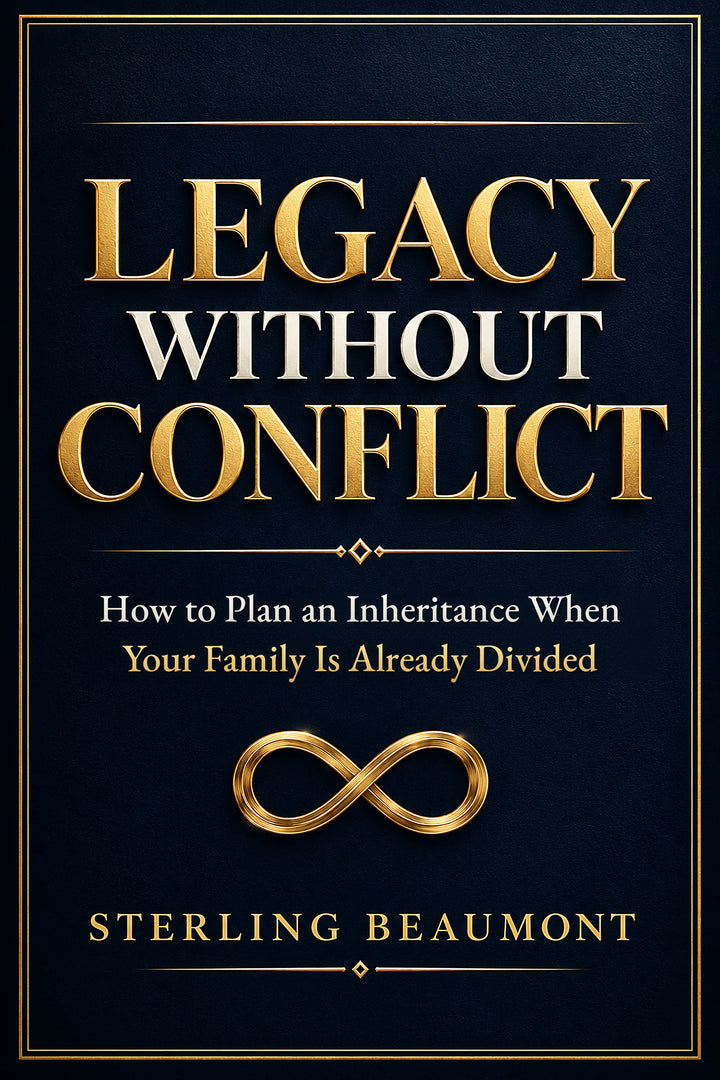
A child in recovery. A child who gave years of care. A child who no longer calls. A second marriage, stepchildren, a family place no one can share. Legacy Without Conflict shows you how to plan for the family you actually have, and explain it while you can, so your children don't end up fighting over what you left.
Inside: word-for-word conversations for each hard situation, sample letters of explanation, questions to take to your attorney, and guidance for an executor caught in the middle.
Not sure yet? Read Chapter 1 free (PDF) or see one decision worked through.
Chapter 1
Margaret learned about the new will in a conference room.
Three weeks after her mother's funeral, the attorney read it aloud. The house went to her brother Paul, who had moved in to care for their mother in her last three years. The old will, the one Margaret had watched her mother sign, had divided everything equally.
She didn't shout. She went home, couldn't sleep, and at three in the morning began building the story that would cost her a brother. A month later she hired an attorney. The challenge took twenty-three months to settle. It ended with Paul keeping the house and paying Margaret a sum that didn't cover her legal fees.
They haven't spoken since.
Margaret's family is a composite, built from the patterns that recur in real inheritance disputes. The decisions are real. The names are not.
READ THE WHOLE OF CHAPTER 1 (PDF) →Now it's her turn
How do I keep my children from doing to each other what my brother and I did?
Margaret is 67 and remarried. Her daughter Laura has quietly become her caregiver, and is keeping score. Her son Danny is twenty-two months into recovery from opioid addiction, and an equal third would put about half a million dollars in his hands. Her youngest, Kate, hasn't spoken to her in four years. There's a lake cabin every one of her children thinks is meant for them, and a will written before her second husband was in the picture.
The book follows Margaret through every one of those decisions, and shows you how to make your own.
Before you read on
You may already have some doubts.
You may be thinking this is morbid. It isn't about dying. It's about the years you have now, and using them to explain your decisions while you can still answer questions.
You may worry that raising it will start the very argument you're trying to prevent. That's why every decision chapter ends with the conversation: what to say, word for word, and how to answer the reactions you're dreading.
You may suspect your children would rather not know. Margaret's family didn't break over the money. It broke over a surprise.
You may feel your family is too complicated, or too far gone. This book is written for exactly those families: the struggling child, the estranged child, the second marriage. And Part III is for families where the fighting has already started.
You may think this is your attorney's job. Your attorney can write the plan. Only you can explain it to your children.
What you'll be able to do
Plan for the family you have, not the one on paper.
Each chapter takes one hard situation and ends with one decision you can explain, defend and live with.
- Decide who gets what when equal isn't fair, and explain it so no one is left guessing what you meant.
- Protect a child who struggles with addiction, debt or money, without cutting them off.
- Plan around an estrangement, whether or not the door ever reopens.
- Recognize the child who gave the care, without the others feeling punished.
- Provide for your spouse and your children in a second marriage, instead of choosing between them.
- Decide what happens to the family place that no one can share or afford alone.
- Choose an executor who can survive the job, and shield them from attack.
- Have the conversation you've been avoiding, with word-for-word scripts and answers to the reactions you're dreading.
Look inside
Fourteen chapters. Eight hard situations.
Third Edition, 200 pages. Every decision chapter ends with the conversation, what to say and how to answer the likely reactions, and a page called Take This to Your Next Meeting for your attorney, advisor and accountant.
DOWNLOAD THE CONTENTS AND CHAPTER 1 (PDF) →Part I · Why families fight
1. How Inheritance Fights Start
2. What Money Means in Your Family
Part II · The hard situations
3. The Child Who Struggles
4. The Estranged Child
5. Siblings Already at Odds
6. The Child Who Gave the Care
7. A Second Spouse and Stepchildren
8. The In-Law Question
9. The Place No One Can Share
10. When Your Executor Is Attacked
Part III · When conflict has begun
11. Spotting It Early
12. Mediation
13. If It Goes to Court
14. Repair
Plus: the Epilogue, sample letters of explanation, guidance for the executor in a divided family, preparing for mediation, questions for your professionals, a glossary, and full source notes.

Swipe to turn the pages →
Three pages from Chapter 3, as printed: Danny's story, a tool for deciding whether past help was a gift, a loan or an advance, and Margaret's conversation with him, word for word.
Three perspectives on every decision
One decision your family can live with.
Legal
What the law allows, what it requires, and what can be challenged.
Financial
What each option costs, what it protects, and which mistakes are expensive.
Psychological
How each option will feel to each person in the family, and what they'll believe it means.
When the three disagree, and in this book they often do, the law sets the boundaries, the costs are weighed side by side, and where the extra cost is modest, the option your family can live with usually wins.
One decision, worked through · Chapter 3
Should Danny inherit the same way as his sisters?
Danny is twenty-two months clean. Under Margaret's current will he would receive about half a million dollars in a single payment. Over the years she has also given him $62,000, with nothing written down. Here is how the three perspectives see it.
Legal
An outright share can be reached by creditors. His part of her IRA passes by its beneficiary form, so changing the will alone won't protect him. Help with no paperwork is usually treated as a gift.
Financial
A large sum arriving at once, in early recovery and in grief, is a risk in itself. A trust has fees and tax costs, so it has to be set up and run well.
Psychological
A trust can sound like a verdict: you'll never be trusted. And his sister Laura has watched years of rescue, and fears she'll be the one asked to keep rescuing.
The integrated decision
Protect the share without shrinking it, and explain it as protection, not judgment.
- Danny's share stays equal. Cutting it would read as punishment, and make a challenge more likely.
- It's held in a trust run by a trust company, not by Laura, so she never has to say no to her brother.
- The trust has a path: more freedom as he stays stable, and the option to become a co-trustee at 50.
- The IRA beneficiary form is changed, so his part of that goes into the trust too.
- The $62,000 is forgiven in writing, so his inheritance doesn't begin with a bill.
This is Margaret's decision, shown as an illustration. Whether a trust, a beneficiary change or a forgiven loan suits your family depends on details your attorney and tax adviser need to check.
“This is me protecting what you've built. It's not me judging you.”
Chapter 3 gives Margaret's conversation with Danny word for word, and what she says when he hears judgment, when he asks why Laura gets hers outright, and when Laura asks why the money is being forgiven. Seven more hard situations follow, each worked through the same way.
Built on research
If your family feels fragile, you're not alone.
In a nationally representative survey for his 2020 book Fault Lines, Cornell sociologist Karl Pillemer found that 27% of American adults were cut off from a family member: 10% from a parent or child, and 8% from a sibling. Fidelity's 2025 Family & Finance Study, which surveyed parents aged 55 and over with at least $500,000 in investable assets, found that 68% had not shared inheritance details with their children.
You'll see more dramatic claims online, that most families fight or a third end up in court. The book doesn't use them, because no reliable source stands behind them. What's known is enough to take seriously.
The book also draws on perspectives from six professionals who work where wealth meets family life, including a neuropsychologist, a family therapist, financial therapists and a former private-bank family office director.
Contributors' views are their own. Their inclusion does not mean they have reviewed or endorsed the book.
The other ending
The following summer, at the lake.
The book ends at Hollis Lake, a year after Margaret starts planning. Danny arrives in his own truck. Frank has become the family's grill man. And on the Wednesday, there's a guest at lunch that Margaret had long since stopped hoping to see.
Not everything is easy. Laura and Danny manage four days before they argue. But Danny comes back, and Laura makes him a plate. That ending isn't luck. It comes from decisions made, and explained, ahead of time.
Questions readers ask
Is this book for you?
My family is already fighting. Is it too late?
No. Part III is for families where conflict has already begun: how to spot it early, how mediation works, what court really involves, and how families repair. Appendix B is written for the executor caught in the middle.
Do I need to read Book 1 first?
No. It stands on its own. The $84 Trillion Shift covers the decisions every family makes; this book is for the families where those decisions are hardest.
Is it written for the US?
Yes. It uses US terms and flags where state law varies. The family decisions and conversations apply anywhere, but readers outside the US should check legal details with a local professional.
Can adult children read it?
Yes. It's also written for the adult children caught in a divided family. It helps you understand what your parents are weighing, and what to do if a dispute has already started.
Does it replace my attorney?
No. It's educational, not legal, tax or financial advice. It's designed so you arrive at your attorney's office prepared, with your situation named and your questions written down.
Paperback, hardcover or Kindle?
All three are available on Amazon. The hardcover makes a good gift for a parent, a sibling or a client. If you're unsure, read Chapter 1 first.
Related reading
Free guides for families under strain.
Can't see your situation? Describe it in your own words and we'll point you to the right guide.
- Can a parent leave everything to one child?
- Leaving an inheritance to a child with an addiction
- Special needs trusts: leaving an inheritance to a child with a disability
- Inheritance and an estranged child: your options
- Should the child who cared for you inherit more?
- How to write a legacy letter to your children or grandchildren
- How to disinherit a child, and what to think about first
- Do stepchildren inherit? Inheritance rights in a blended family
- How to protect your children's inheritance from in-laws
- How to remove an executor, and what to try first
- When siblings accuse the executor: what to do on both sides
- Paying a family member to be a caregiver
- Leaving a vacation home or cabin to your children
- Inheriting a house with siblings: what to do when you can't agree
- What to do when your siblings are already fighting over the estate
- Undue influence in a will: the signs, and what you can do
- Estate mediation: how it works and why it beats court
- How to contest a will: grounds, deadlines and what it really costs
- What to do when one child is financially irresponsible
- Inheritance in a blended family: protecting your spouse and your children
- Leaving the family house to one child without breaking the family
- When your sibling has power of attorney over a parent
- How to write a letter explaining an unequal inheritance
- Life interest trusts for a second marriage
- Using life insurance to equalize an inheritance
- Incentive trusts, and when they backfire
Not ready to buy?
Start with the free Legacy Conversation Toolkit.
Three questions to answer first, a ten-point family readiness check, and seven conversations, each with an opening question you can ask word for word. Eight pages, about thirty minutes.
Already signed up? Your download link is in your welcome email. Can’t find it? Enter your email above and the link will appear.
For attorneys, advisors and mediators
A book to give the clients with the hardest families.
Designed to be given before an estate-planning review, a family meeting or a mediation. It opens with a short exercise clients complete before their next meeting, and every decision chapter ends with questions written to be brought to a professional. Volume orders and firm-branded editions are available.
ENQUIRE ABOUT VOLUME ORDERS →After the book
Families rarely fight over a plan they understood. They fight over surprises.
The Beaumont Family Legacy System helps you take the surprises out: a 34-page fillable workbook to agree what fair means, run the first family meeting with ground rules so it stays calm, write down your reasons, and finish with a 90-day plan. It includes the 60-Minute Family Emergency Binder. Instant download.
Leave your children an inheritance, not a war.
Legacy Without Conflict · Third Edition · Hardcover, Paperback and Kindle on Amazon
Hardcover $33 · Paperback $28 · Kindle $12.99
Or read Chapter 1 free first (PDF)
Margaret's family is a composite, created to show common inheritance conflicts. This book is educational and is not legal, tax or financial advice.